Bridging Technology & Capital.

Class 12 Student | Finance Enthusiast | Decoding Markets through Code

While my younger brother looks up at the stars to map constellations, I prefer looking at the ticker tape to find patterns.

I am Dhruv Saxena. I am a debater, a coder, and an athlete. I’m not just here to watch the economy evolve; I’m learning to write the code that will drive it.

View My Work
Dhruv Headshot

"The important thing is not to stop questioning."

— Albert Einstein

Beyond the Vocabulary

Surrounded early on by discussions of market shifts and global finance, I quickly realized that understanding business terminology wasn't enough - I wanted to build the mathematical and computational engines behind it.

Knowing the words isn't the same as writing the code.

That realization pushed me to stop just watching the markets and start learning how to build the tools that analyze them. I moved away from relying on exposure and began actively studying Computer Science. Currently, I am focused on learning Python, building scripts that track stock volatility, and translating market chaos into algorithmic logic.

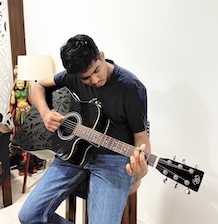
I have learned that the discipline required to master a complex chord progression on my guitar is the same discipline needed to debug an algorithm. The strategy required to predict an opponent’s bowling in cricket is the same mindset needed to spot a market trend.

Academic Profile

Class X: 94%
Class XII: 97% (Projected)
SAT: 1440 95th percentile

Math 780 98th percentile
EBRW 660 86th percentile

TOEFL iBT: 5.5/6

Focus: STEM & Finance

Download Resume

Key Projects

Analytics
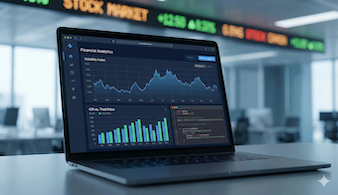
Financial Analytics

Equity Risk Analysis Tool - Phase I: Volatility Screening

Problem: Novice investors often mistake high-volatility "hype" stocks for safe, stable investments, leading to capital loss.
Action: Used Python to calculate 30-day historical price variance, identifying underlying volatility often missed by the market.
Result: Developed a data-backed risk assessment framework to objectively evaluate asset stability.

Finance Tool
Quantitative Finance

Equity Risk Analysis Tool - Phase II: Beta & Sentiment Modeling (v2.0)

Problem: Purely statistical trading models often fail because they cannot account for the sudden, unpredictable impact of breaking news and geopolitical shifts.
Action: Built an analytical model tracking Beta to measure specific stock volatility against broader market movements.
Current Focus (V2.0): Pure statistics can't predict human panic. Building a Python-based AI agent that evaluates historical stock trends (variance, covariance) while simultaneously running sentiment analysis on financial headlines, to test whether combining the two gives a sharper read on risk than either alone.

Research
Research & Policy

The Architecture of Impulse

Problem: "Buy Now, Pay Later" apps often use deceptive "Dark Pattern" UI designs to trap students in impulse debt cycles.
Action: Audited the checkout flows of 3 Indian BNPL apps and surveyed 52 Gen Z respondents (ages 16–21) to identify specific predatory design elements and measure their real-world effect.
Result: 44% of respondents were regular BNPL users (3+ times a month). Of those exposed to false-urgency prompts, 82% reported making an impulse purchase; of those hit by hidden late fees, 65% went on to miss a payment. The paper proposes concrete fixes - a mandatory cooling-off window before checkout, a ban on pre-selected auto-pay, a clear "cost-of-credit" label, and income-verified age-gating.

Professional Exposure

April 2026 – June 2026

WalkingTree Technologies

Agentic AI and Data Engineering Intern

The Context: To understand what happens before an AI model is actually trained. I joined the engineering team to understand the raw data foundation that powers supervised learning.

The Work: Supported the core machine learning pipeline by manually segregating, labeling, and quality-checking training data - roughly 30-40 records a day.

The Takeaway: Caught a data point that looked like an error - a 50% overnight price drop and traced it back to an ordinary stock split rather than a data quality issue. It taught me that good data work isn't just about spotting anomalies; it's about knowing which ones are actually meaningful and which are just the market doing something normal.

April 2025 - May 2025

Techcompiler Data Systems

Quality Assurance (QA) Intern

The Context: Working inside a CMMI Level 3-certified engineering environment gave me a front-row seat to the actual software development lifecycle (SDLC) and how products go from code to the end-user.

The Work: Responsible for manual "smoke testing". Before the senior developers did their final checks, I tested new web and mobile apps exactly as an everyday user would, actively trying to find broken links, navigation errors, and layout bugs.

The Takeaway: Learned that writing the code is only half the battle. I learned how to clearly document and explain the exact bugs I found so the developers could easily fix them before the app went live to real users.

Impact & Leadership

Change With One Meal

Fundraising & Organizing Lead,
in partnership with the NGO

  • The Mission: Partnered with Change With One Meal, an existing NGO in Delhi providing subsidized ₹10 meals to daily wage workers, to lead a digital fundraising campaign closing the funding gap.
  • The Action: Mobilized school and local community networks through Milaap to fund the ₹28 gap between each meal's ₹38 cost and the ₹10 the worker pays.
  • The Impact: Raised ₹25,000, sustaining daily subsidized meals for 30 workers for a full month.

Robin Hood Army

Active Volunteer,
Hyderabad Chapter

  • The Mission: Combating food waste and hunger at the grassroots level by acting as a bridge between surplus food and marginalized communities.
  • The Action: Regularly participate in local city drives, including surplus food distribution, clothing collection, and community blood donation camps.

Model United Nations

Delegate & Mentor

  • The Role: Active delegate across multiple conferences, including NTU MUN Singapore and Fairgaze India (High Commendation, 2025), debating complex geopolitical and economic policy.
  • A Highlight: In a UNODC committee, built Excel pivot tables from public corruption and economic-indicator data to analyze how sanctions affected regional economies - bringing the same data-driven approach to policy debate that defines my other work.
  • The Impact: Publish all position papers and research submissions publicly online to help novice delegates prepare.

Media & Gallery

Let's Connect

Open to conversations on quantitative finance, behavioral economics, and collaborative research.

Send an Email